
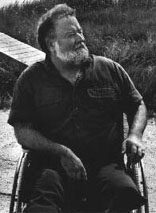
A Man Named Father Clarence Stanghor
A man named Father Clarence Stanghor, the Chaplain at the University of Iowa's Student Chapel, in a very real sense helped me write this story. I was in the writers' workshop there at the time, and he and I became friends. He used to come over to our house at night and talk about all sorts of things. We did some drinking together, and I pretty well talked through the theme of "If They Knew Yvonne" with him.
He had actually been raised a Lutheran and didn't become a Catholic until after World War II. A man of experience, he told me that the book on moral theology or ethics they used in the seminary promoted the idea of caveat emptor--let the buyer beware. It also said--and Norman Mailer has also been quoted as saying this, and I have only respect for his genius and individuality and bizarre, wonderful intelligence--that rape is a preferable sin to masturbation because rape is a natural act.
When he got out of the seminary, Father Stanghor burned that book.
I had gone to school with the Christian Brothers, and talking with Father Stanghor, I told him that I had come to the view--and maybe this was only because the Christian Brothers rather than the priests taught us everyday in school--that the Brothers had emphasized the act of orgasm so much that they had made us solipsistic and consequently we had not learned about sex in the context of its involvement with human beings, what pain or what good it brings to them.
As you see, Father Stanghor helped me write this story.
The characters of Yvonne and the sister were made up, so in a sense, everything bad in the story was true and anything good in it was not true with the exception of the priest.
Once in Iowa I went to confession to Father Stanghor, and it was a very long face-to-face confession in the lounge of the Catholic Union, a very long and complicated confession which I see no reason to go into here. But at the end of it, I said to him that I would like to receive absolution, and he smiled and asked, "Would you like the whole thing? The stole?" I said yes, so he put on the stole and went to his office, and I knelt and started, "Bless me, Father, for I have sinned, my last confession was long ago, and I wish to confess what I just told you over the past two hours."
He said, "For what you have learned this summer, for your penance, say Alleluja! three times."
Also, regarding my novella Separate Flights, I was once involved in a seminar in which that story was being discussed. There was a priest participating, and I asked him what he would have told Beth, in confession, if she confessed her intention to commit adultery, even though circumstances had prevailed against her carrying it out. The church, of course, teaches that you can sin by intention even if not by act. He said that he would have told her that her problem was one of the soul and that right then she was too depressed to be capable of sin.
In "If They Knew Yvonne," Father Grassi quotes Saint John, saying, "I do not pray that you take them out of the world, but that you keep them from evil."^ He is telling the boy, Harry Dugal, that one must join the world rather than run from it. That you cannot avoid evil by avoiding life, but you must face life without committing evil. I am a Catholic, but I do not believe in any set of rules that keeps people off the dance floor.
I have been sustained by the Eucharist, and I went through a year with my ex-first-wife discussing and reading about artificial birth control, trying to figure out where the truth was. We decided to practice it. I do not think I am a maverick to the church. I agree with a quote from Dorothy Day from Romano Guardini: "The church is the cross upon which Christ is crucified. We can not separate one from the other."
That could sound like I am saying I am more Catholic than some people, but that is not what I am saying. What I mean is that the church is taught by men and women. The views of the church are distorted and the teachings which come to people like you and me get distorted.
I had incredible masturbation guilt as a child, and I grew older to see something deeper and absolute and eternal and something that transcended all of that and is represented for me in the Eucharist, in sharing in the body and blood of Christ and by so doing sharing in the body and blood of the entire world.
I think through weakness, greed, evil, ignorance, and human failures that the message of Christ has often been distorted.
As a young priest said in Mass only the other day, "How many murders have been committed in the name of Christ?" But also how many murders of young souls have been committed in the name of Christ, too.
So I am not saying with "If They Knew Yvonne" that I am a maverick in the church. I just don't believe in the Pope and a lot of other stuff that the church believes in, but I feel much better about the church. We now have dead nuns in Central America, and I'm sure that is how it is supposed to be.
As for the Pope, as I said in "A Father's Story," I believe that the Pope should live in a little cabin, and he should sell everything and give it to the poor. The mystic/supernatural nature of Christianity is what I love. The political/commercial structure of the church hierarchy I see as corruption.
Anyway, I have written about characters who do receive the Eucharist according to their state of grace, and that is not according to the church laws stating whether or not someone is in the state of grace. I have not believed in that particular definition of the state of grace for a long time--since I was about seventeen years old when a Monsignor in Lafayette, Louisiana, said, "No one can ever tell you when you can receive Communion."
In fact, this is close to something that Harry's sister, Janet, says in "If They Knew Yvonne." She tells her brother that she went to Communion every Sunday despite the fact that for technical reasons--being married out of the church, using artificial birth control--she was not, by the church's definition, in the state of grace. However, when she is having an affair she does stop receiving Communion--not because of the affair as such, but only because "he loved me and I was using him."
This theme is at the heart of "If They Knew Yvonne," and these are some of the source materials that went into the writing of it.