 Essay from The Literary Review
Life in My Cube
BINO A. REALUYO
I. The Cubicle
| Cubicles: I've known them for a little more than ten years now. Or perhaps longer, for I was a certified Manhattan Temp during my summer months away from college. I've worked in all kinds of offices, from downtown investment firms to uptown hospitals. But always in a cubicle, box-shaped, rib-high fences made of plastic and cloth, sometimes gray, sometimes black, but always in dark colors, to contrast the light shades of the office walls. My cubicle right now has these nice little cushiony walls on which I can stick pins or scotchtape pictures, memos, or travel souvenirs in form of tchotchkas (hooked on carefully stretched-out paper clips) from my co-workers' vacations. |
|
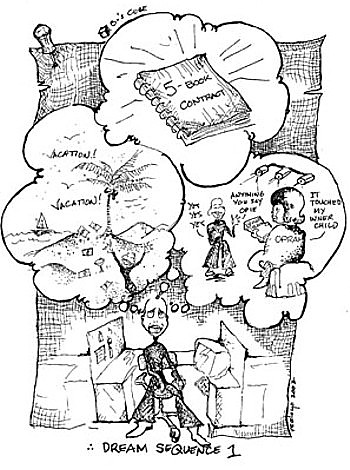
Drawing by Bino A. Realuyo
|
II. Stuff
On the C-shaped desk protruding out of the cubicle wall: a 19-inch computer monitor (the largest in my office), folders scattered all over, a green lamp that has a note stuck on it (says “finial,” a missing lamp gadget which I have been trying to buy for years), supplies and more office supplies. My desk has been consistently voted the messiest in my office. I am not masterful in filing. I don't like the idea of putting anything away. So I leave paperwork on my desk. Paper grows on my desk like bad story ideas that visit me from 9 to 5. I have paper guilt. I store them on my desk until the day I realize I haven't looked at them for so long they must be useless. From time to time, I tell my co-workers I don't understand why we waste so much paper. Why we don't have a recycle bin. I don't understand why we send each other tons of memos, when interoffice e-mail is just as effective, or a more personal verbal reminder would probably suffice. They hand me the memos anyway. In the office, we don't have political convictions. Paper has become as necessary as paper clips. Without paper, we will not learn about our next staff meeting. We won't know we have to bring our own breakfast. The same principle goes with coffee. Everyone has coffee on his desk, when most of us don't even drink it. Coffee is an office necessity you see, a habit much like turning on the computer as soon as one walks into his space. It has to appear on desks in the morning in a brown bag before we hang our coats in the closet. We don't have to touch them, however. They just have to be there. A friendly support system (the way tchotchkas bring smiles). I have stains to prove my coffee habit. Cup stains crisscross my desk like viruses happily mating. Sometimes there are little concentric circles on my folders, sometimes in the middle of the desk, or my calendar, and some dried spill here and there on my keyboard. I clean them up at the end of the week before they take the form of a religious apparition. Sometimes I stare at them and am reminded that no matter what, life is not so bad after all.III. Officewear
My income goes to the clothes I wear. I'm addicted to designer labels. They help my shattered writerly ego. I buy clothes to show off for the few minutes I'm out in the streets and for the hours I spend in the office. I'm especially conscious about my pants. They have to be the right cut. Most stores sell pants to men with waistlines of 40 and above. Two of me can fit in one. And they are so long so that getting them hemmed might mean getting an extra pair of shorts. For the right cut of pants, I go to boutiques. They shouldn't have pleats. They should be cut straight from the waist. And if they are bell-bottomed, the better. My legs need to breathe for the hours I spend sitting down. Anything tight will clog my leg pores. And whoever says hairy legs don't suffer from the daily wear and tear of pants. So my office pants need the space to breathe. The color is always dark. Everything I wear is dark. From my jacket to my dress shirts to my coats. Dark. If you wear something colorful in New York City, I can guarantee you the subway train won't stop for you. Fashion in Manhattan only comes in shades of gray. And I follow such rules. It's black, gray or brown, all tones, all shades. No overtly blinding colors of the State of Florida. No one wears colors in my office. It's the dictates of our fashionable inner child. She believes in darker shades of reality as much as we do. She worships in the religion of Prada, Calvin Klein, and DKNY. She knows that a tinge of color might just add too much excitement to our controlled eight-hour routine. From time to time, someone wears color, and that becomes the momentary topic of the day. Colors are so identifiable that you can't wear the same outfit again. I think people who had a bad breakfast or didn't sleep well wear colorful clothes. Colors don't hide illnesses. For insomniacs, wear black.IV. Chats
Conversations spice up the time spent at work. There is truth to some prime-time shows where the characters spend almost their entire work time chatting up a storm. I, for one, love to talk. I make up for the days and nights spent alone at home trying to get inspired. When I get to work, conversations begin immediately at 9 a. m., sometimes with “Could you share your coffee please, please, please?” Between work, conversations range from what is happening in the world to what is not happening to our lives. I am surrounded by adults who are in their twenties and thirties. The majority is single. Single life in New York City is definitely something worth discussing in the office. We are a different species of humans. We try hard to think we are not rejects, only because there is certainly power in numbers. We are convinced everyone in this city is single. And in camaraderie, we all begin sharing our romantic nightmares at work beginning at 9 a. m. We exchange tips and stories, long, painful ones that reveal the inner workings of our social dysfunctions (deep in our heads, we are interjecting ah, that's why you're . . .). I am not sure whether the married ones are necessarily lucky. I certainly don't want to be in their shoes. They come to work hardly breathing. And the phone has a special function in their lives (for yelling at their kids). One day, I will learn CPR just for them. You never know when these breeding types will crack. On the other hand, singledom is very much the thing for most of us. One can tell by the way we act, dress in dramatic black, converse, and leave exactly on the dot at 5 p. m. as if there is another life waiting for us outside the office. And of course, we bring in the excitement of the night before. For that, it is best to share at lunchtime. Cubicle conversations bring in stares from supervisors. Today, I tell everyone that the Department of Health has shut down the sauna at my gym for the unwelcome activities of the older men who go there. I tell them about meeting people at the gym. The married ones listen to our conversations with so much pity in their faces. I am not sure they understand the concept of socializing during aerobics. “Pilates” is a word they are not willing to learn. We gather around a long table, bringing lunch our mothers made for us, their poor single children, and begin conversations from A to Z. They are all meaningless topics. The next lunch day, we will begin another conversation about strangers we notice on the subway train (once, we talked for a whole week about the Asian woman whose feet got caught on the train). But at least, the world is alive for us. I share my wisdom with everyone. Sometimes I think I'm a shaman. I tell everyone proverbs I make up at that very moment. It helps to be articulate. They probably don't really listen to me. But at least, we laugh. We eat, we laugh. We go back to our cubicles full of a little bit of new things.V. The Phone
My telephone is a useless gadget. It rarely rings. In cubicles, you can't really have a personal conversation. Or you can talk low and pretend no one can hear you. I listen to conversations of my co-workers. Not that I want to but I have no choice. We are so close to each other I can hear them breathe. Their personal phone conversations appear in my dreams. I learn more about my co-workers than I am willing to. Sometimes I bring it up in conversations and they give me this look wondering how I have found out such gruesome details. Once, I found out my co-worker's real name. I wondered what else was not real about her. In making personal connections with the outside world, I very much rely on e-mail. I tell everyone not to call me unless it's absolutely necessary. Sometimes I have this desire to hear a human voice. But since I work with about a dozen people, I might have enough human interaction for a day. I need to spend time alone, if I am to get any writing done. At home, I also don't answer the phone. I find myself online a good many hours during the day. It's not a distraction, but another friend. Even at work, my Internet is always on. When I'm getting a bit tired, a good short article on just about anything perks me up. Who needs to make phone calls when one can get e-mails from all over the world? I prefer e-mails over phone calls. People have stopped calling. If the telephone disappears from my desk, I will not know. It has one function: I pick up the receiver when someone I don't want to talk to walks by my desk. Otherwise, I think, just like my coffee, it sits there as part of my club of office supplies. It has to be there, because it has been there since the modern office was invented. A relic. Or for me, a contemporary living sculpture.
 |
|
Drawing by Bino A. Realuyo
|
VI. The Mini-signing
At my cubicle, I sign copies of my books with my green-ink pen. Surprisingly, people come to my desk with copies of my book at hand, expecting me to sign them, and sometimes, expecting a conversation. To begin, I give out little friendly postcards so that my friendly buyers can give them to their literature-friendly friends. I didn't plan on doing this. It's just that everywhere I go in my organization, someone asks me about my second novel. While what I really wanted to say is: Do you think I can really find time to write a second novel when I spend most of my precious time working here? (wink.) What comes out of my mouth is: Did you buy my first? And when I get a blank stare, I walk away. For my patrons, however, I write special dedications on the first title page of the book. I don't expect anyone to read my work, although when someone comes back to tell me he has read the book, I am almost always completely surprised, or at least, pretend to be, and am embarrassed to express my desire to know more. I get worried that my co-workers around me may be getting tired of listening to people talking about my first novel. But I don't bother to ask them if they are. Sometimes I summarily end the discussion with “tell your friends about it,” only to end another day of book discussion. More and more people at work find out that I am an artist who has to work full time. They no longer wonder if I have made my first million because I have published a book. Instead, the reality of the life of a writer has become clearer to them because there is not a moment I don't share my angst when I lose a grant or a fellowship. Sometimes I wonder which one is my second life—my writing or this job. This is certainly not just another day job. I love being here. I look forward to coming here. In fact, it is harder for me to end this week and transition to my solitary writerly life on weekends, when I have absolutely no one to talk to but images in my brain. Writing full-time is a permanent fantasy, unreachable at best. Until then, I will make my green-ink pen available for signing.
 |
|
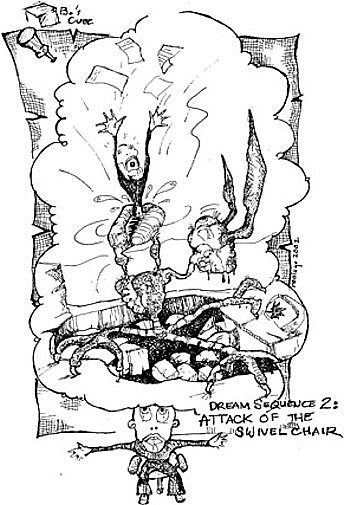
Drawing by Bino A. Realuyo
|
