
Interview with Novelist Chris Huntington, author of Mike Tyson Slept Here
by Chloe Yelena Miller
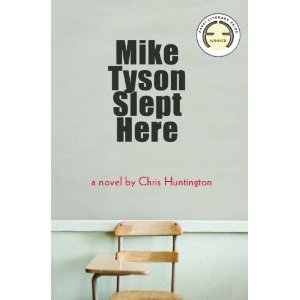
Chris Huntington, author of the novel Mike Tyson Slept Here, winner of the Fabri Literary Prize from Boez Publishing, shares some thoughts on writing his first novel. Chris teaches English in Xiamen, China, where he lives with his wife and their son.
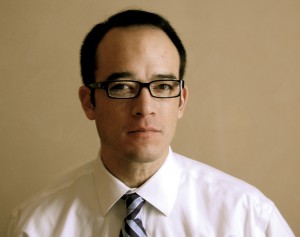
Chris Huntington
Mike Tyson Slept Here draws upon the author’s experience teaching inmates at Indiana’s Plainfield Correctional Facility to create a fictional narrative of Brant Gilmour, a GED teacher entering the correctional system. Brant’s voice isn’t the only one; threaded throughout the novel are other voices and narratives. Most uniquely are the three chapters entitled Overheard and one poem (called a Pome) which give voice to those working and living in the prison. Huntington offers a full and thoughtful view of not only the world inside the prison, but where it intersects with the world outside of the prison.
One of the protagonists is a young man teaching GED classes at an Indiana correctional facility. You also worked for the Indiana Department of Correction. Can you discuss how your experiences – in and outside of the prison – informed your fiction?
Working in the DOC obviously affected my fiction by giving me lots of stories. I was once asked at a reading why I didn’t just write a memoir. All I can say is that the interesting things didn’t happen to me personally. They happened to dozens of people I met in the prisons over ten years. I felt my job was to organize it all and make a kind of sense of it.
Another thing that working in the DOC did was it made me aware of my language and my ambition. It occurred to me that if I am writing about a prison and nobody in the prison can make head or tail of my language, then how well am I writing about it? Do you know what I mean? I have a tendency to overwrite. I look at my journal and it’s incredibly boring. I write what seems –at the time—to be important thoughts about the color of trees or sound of clocks or some bullshit, and it’s all just completely ridiculous and ultimately uninteresting. I reread my journal and I find myself skipping pages. Left to myself, I have a tendency to attempt a lyricism that is actually quite ridiculous.
Working in the prison, I thought: if I’m going to write about this place, I want these guys to read it and say, “That’s me, that’s my life.” I can’t count how many inmates I got to read “Sonny’s Blues” by James Baldwin. I found it in an anthology of great American fiction I found in the prison. Anyway, my students were all excited when I told them “Sonny’s Blues” was about a guy whose brother had been locked up for a long time and was just getting out of prison, and there was all this stuff the two needed to say but they were struggling over it. My students would practically tear the book out of my hand. But none of them liked it. None of them recognized themselves in it. I’m not saying I succeeded where Baldwin failed. But I realized that maybe I wasn’t writing for the same audience, which in his case was the readership of an anthology of great literature and in my case was everyone I had ever met.
I really enjoyed the organization of the chapters. You shift the point of view and periodically include short “Overheard” chapters that animate the setting (the prison.) Can you discuss your decision to structure the book in this way?
Thanks for that. I worried that the mixture of play and poem and narrators would be perceived as gimmicky or unfocussed or distracting –but I felt committed to it for a variety of reasons. I didn’t feel I could tell the real story of a prison through a single narrator because in a prison there a thousand very dramatic stories side-by-side and the amount of sheer ignorance regarding what each person knows about the others is just amazing. Prison really is a place where, on one hand, nothing is happening, but on the other, many things are happening at once. I wanted to capture some of that –the quilted nature of all those voices speaking at the same time.
My other major consideration was that I wanted this book, above all else, to be readable. I wanted to write a book that would pay off within the first five minutes a reader had it in his or her hands. I know that myself, at night, if I have a long chapter ahead, I put a book down, but short chapters often leave me thinking: “Oh, I’ll just read one more.” I wanted each chapter to tell the reader something new (about some new aspect of prison, for example) and I wanted each chapter to ask a question, in a way- be a little mysterious at the edges.
Of course, as a poet, my favorite “Overheard” chapter is the “pome” written by an inmate. This initially rough and then tender poem comes in the last third of the novel. Since the poem’s author remains nameless, it gives the inmates, collectively, more heart. Similarly, a central theme of the book is a question about the humanity of both the inmates and the employees of the correctional facility. Did you intend to present a final, political message about prison systems in the United States through your novel?
I didn’t have any political aim in the book. I do have political feelings about the way we incarcerate so many of our citizens, especially people of color, and I despise the gerrymandering and disenfranchisement connected to prisons, but I wasn’t trying to write Uncle Tom’s Cabin or a piece of propaganda. The fact is: most people don’t care what is happening in our prisons. But I think most people are concerned with how it feels when you fall in love with the wrong person. I wanted to write about that. I wanted to write about prison life, obviously, but even more than that I wanted to write about what it’s like to feel yourself growing into a person you have mixed feelings for.
Congratulations on winning the Fabri Literary Prize from Boez Publishing. Readers, who have not yet published an entire manuscript, are always curious to know about how books get written and published. Could you share a bit about your writing and submission process?
This is always the part of a writer interview that interests me the most . . . but it fills my eyes with tears when I find a writer I like and then read him or her saying, “How did I get published? Well, in my second year at_________(Iowa, Stanford, other universities), my _________(teacher, someone famous) gave one of my stories to _______(agent/editor/magazine)______ and I graduated with a ______ (1-2-3 book/movie deal), though I hadn’t actually written a ______________(word/novel/ story longer than an e-mail) yet. You can fill in the blanks in a mad-libs way, but it still seems to fit a lot of new writers.
I should be happy. I should tell myself that the system works because this might be coming from a writer whose work I admire. I should be glad that this work stood out to someone and that it blazed through and got printed and into my hands and this writer is not wasting the best years of his or her mind grading freshman composition online. But instead I always think of the years and years of rejection I’ve gone through.
I wrote and sent stuff out on my own for ten years. I wrote a lot of stuff that I liked, but which no one else did. I wound up doing a low-residency MFA (at Bennington College) and met some very talented writers and one of my mentors, Tom Bissell, did his honest best in just the way I’d read about –he recommended me to editors and a couple agents—but nothing came of it, which made me feel even more a failure, if that makes sense. I felt a bit like I’d been given this rare chance and struck out. Like, obviously my life was not the life of a writer because all my heroes had gotten books published when they were much younger than me. But I kept at it, though my pace of writing slowed as I got married and my commute got longer and I became a father.
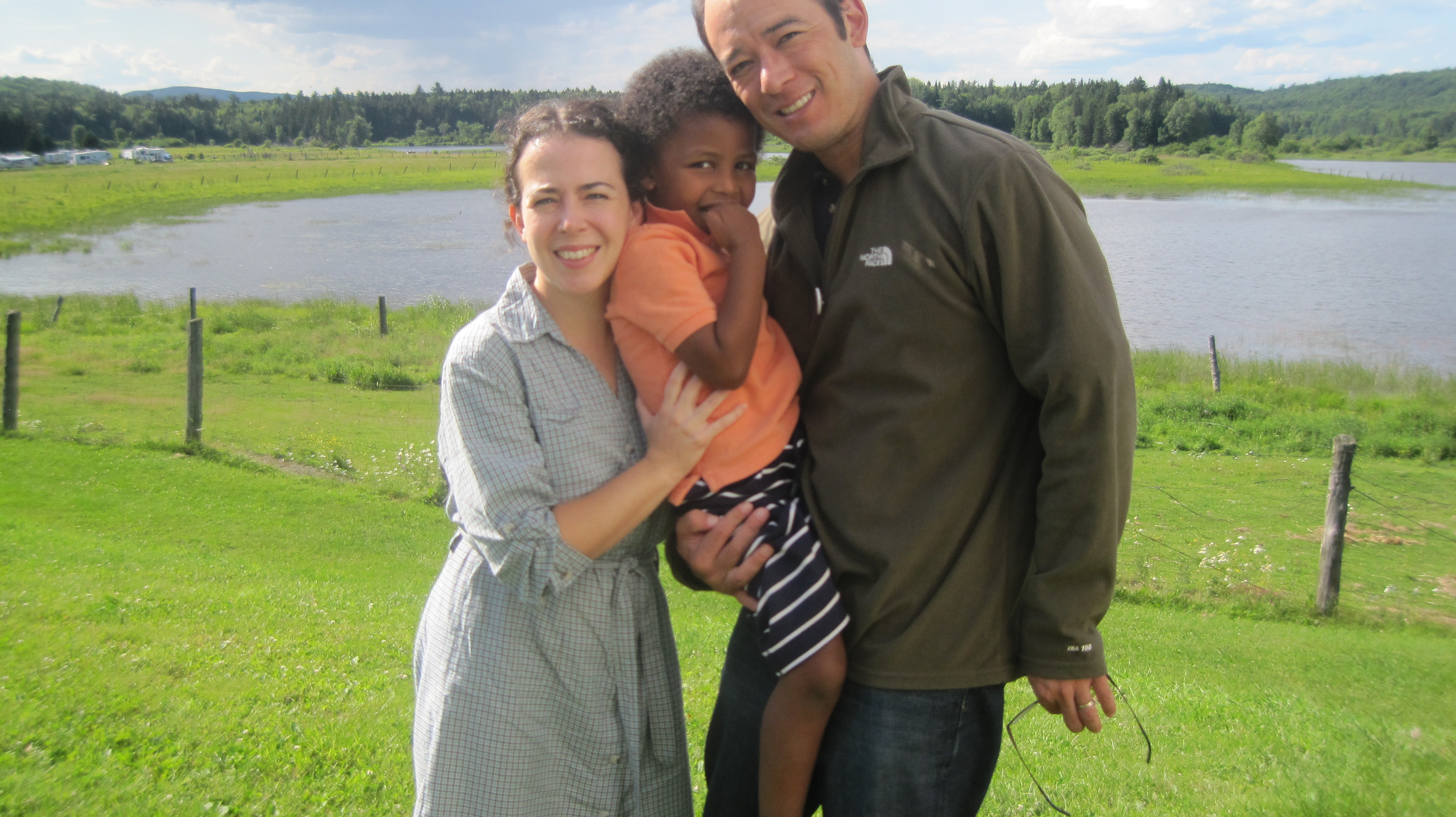
Chris Huntington, his wife Shasta Grant, and their son.
I still sent stuff out, but with a constant feeling of guilt because I knew I was only doing it sporadically and it was or should have been a full-time job. Anyway, I sent the first thirty pages of Mike Tyson Slept Here to the contest (for the Fabri Prize) and forgot about it. Two months later, I got notice that I was one of three finalists and I called in sick to my day job and spent about a week revising the manuscript. Then, after another bump of time, I got a phone call from Tom Southern at Boaz saying they wanted to publish my book; I’d won.
It hasn’t solved all my problems, of course. I still don’t have an agent and I still don’t have a publisher for my next book or for any of the books I’ve already written. But I do feel quietly proud of myself and I know that it’s changed the way I see my life.
You’ve worked in a prison, completed an MFA program at Bennington College, written fiction and creative non-fiction and more. What was the most helpful thing that you’ve done in your writing career?
The MFA at Bennington was a really positive experience for me. I wasn’t sure it would help, but the fact was, after living in inexpensive but interesting places—but without a community of writers—suddenly being with talented people like Matt Debenham (who later wrote The Book of Right and Wrong) and John Rowell (who published The Music of Your Life just as he was graduating) and having established writers like Jill McCorkle and Tom Bissell take me seriously, well, it made me feel like I could do it, that the distance between the books I was writing and the books I was reading wasn’t as big as I thought, and I started reading with the questions of these different and talented people in my head and it made me better, a better writer. I don’t want to be just a bumper sticker for Bennington –I know everyone’s experience of grad school is different—but, for me, it was wonderful.
Chloe Yelena Miller is a writer in Washington, D.C., where she teaches privately and online.