
At this year’s AWP conference in Washington DC last month, I attended a panel hosted by Ninth Letter, featuring four writers who had read the entire long list for the 1960 National Book Award in fiction in order to re-judge the contest. (The authors nominated that year were heavy-hitters, Saul Bellow, William Faulkner, James Jones, John Updike, and of course, Phillip Roth, the winner).
I was completely intrigued by the idea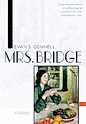 , the concept of evaluating in hindsight literature’s staying power and our ability to predict it, and so decided to read the newly-annointed winner: Mrs. Bridge by Evan S. Connell.
The brilliance of this book is in the minutiae. The novel is comprised of 114 vignettes—with hardly a plot to speak of—and yet, the weight of each moment and the context which it creates for later moments, evokes the feeling that you have actually lived life with Mrs. India Bridge and her husband and three children, in their upper-middle class Kansas City home. Each vignette is so well-observed, so perfectly detailed, that the slightest movement—for instance, placing a napkin on one’s lap—can be both fully of irony, and deeply saddening. The novel counts on a reader’s attention, on having experienced the pages that have come before, and as a result, reproducing an example here is like explaining the punchline to a joke. Something will be lost in the translation.
Still, this is one of my favorites: At one point Mrs. Bridge is eating dinner at the Country Club with her husband and there is a tornado coming. All the other patrons have gone down to the basement but Mr. Bridge refuses, and she, ever faithful, stays with him.
From the distance came a hooting, coughing sound like a railroad locomotive in a tunnel; a very weird and frightening sound it was.
“Well, that must be the tornado,” she said listening attentively, but Mr. Bridge who was eating his cornbread with great gusto, did not reply. She spread her napkin in her lap again although she had finished eating; she spread it because when she was a child her parents taught her it was impolite to place a napkin on the table until everyone had finished, and the manners she had been taught, she had, in her turn, passed on to her own children.
Even in the midst of a natural disaster she refuses to contradict her husband, she feels she has no right to abandon him, which is disturbing enough. But the crowning detail is that although she is terrified, maintains her proper table manners. This is not just a prim woman who reacts with force of habit, but a careful, questioning woman, who clutches to the rules as a way to feel in control. In fact, she likes rules and table manners precisely because there she knows what is expected. With people, even her friends, she has so little self-confidence that she speaks in sweeping generalities; this way, she can never offend anyone. For instance, she and her husband decide to stop using a chauffeur, but when she is “discussing the matter with her friends, some of 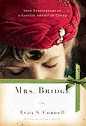 whom had chauffeurs and some of whom were considering it, [she] was apt to say, ‘Well, it does have advantages, but of course there are drawbacks.’”
By the end of the book, when Mrs. Bridge is becoming nostalgic, I found myself getting nostalgic too. And the amazing thing was that although there is great authorial distance (I can’t ignore I’ve spent this whole time referring to her as Mrs. Bridge, not India), I was so securely in Mrs. Bridge’s head, that by the end, when she is upset that her children—who she barely knows or understands—are grown and gone (and although if I had been her child I know I would have grown to reject her and her more-toting, social-grace-before-all-else self too) I felt a deep sadness at their rejection of her. Or maybe, it was a sadness at the idea that Mrs. Bridge tried so hard to impart in her children with the values she thought she should, and that that is precisely what drove them away.
—Jena Salon